
Sanjay Garg, MD & Co-Founder, Oasis Bio Bloom LLP, has 30 years of experience in the pharmaceutical industry.
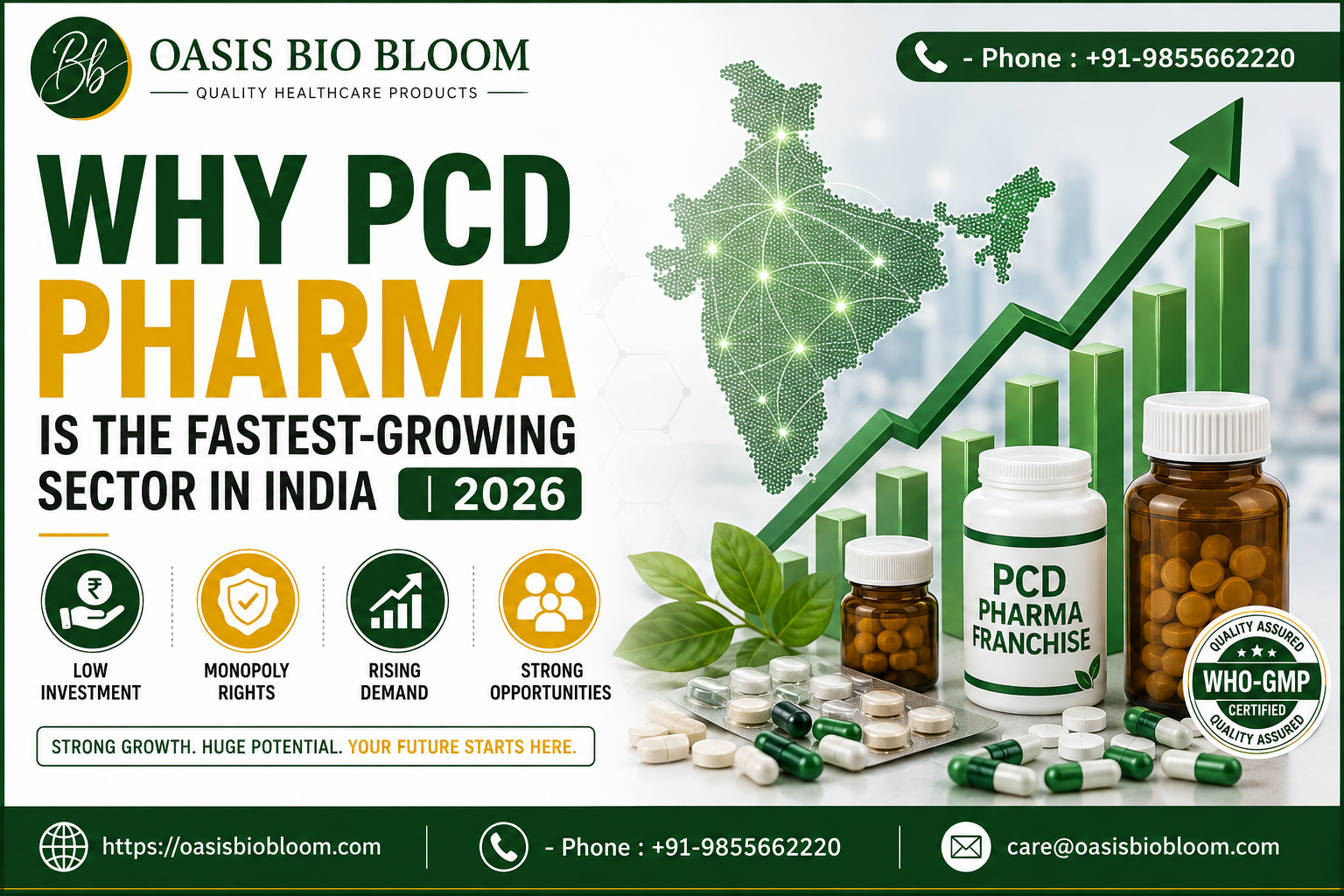
Quick answer: A PCD Pharma Franchise in India is growing faster than almost any other segment of the healthcare industry right now, largely because it requires low upfront capital, offers territorial monopoly rights, and rides the domestic pharma market, which is already worth over $60 billion and still climbing.
If you’re weighing whether to start one, know that the fundamentals are genuinely strong, but the business still rewards the same things it always has: patience, the right products, and a company that actually backs you.
Most of what’s written on this topic recycles the same three points: low investment, no manufacturing, monopoly rights, without ever explaining why those three things line up. Delve into this article to understand the driving force behind the PCD pharma franchise in India.
What’s on this page
The Reason Why PCD Pharma Took Off

I’ve sat across the table from a lot of first-time franchise partners over the years. Most of them ask the same opening question, in one form or another: why is everyone suddenly talking about PCD Pharma Franchise in India?
The answer is that setting up your own pharmaceutical manufacturing unit costs crores, takes years to obtain regulatory clearance, and demands a level of technical infrastructure that most individual entrepreneurs simply don’t have.
A PCD, or Propaganda Cum Distribution, model sidesteps all of that. You’re not manufacturing anything. You’re taking an established company’s already-approved, already-branded product range and marketing and distributing it within a territory that’s yours alone.
That combination, low barrier to entry plus real income potential, is precisely why the PCD Pharma Business in India has pulled in everyone from career medical representatives to first-generation entrepreneurs who’ve never worked in healthcare before.
The numbers behind the boom

Here’s where I’d normally tell you to trust me, but you shouldn’t have to. So, let’s look at what’s actually driving this, according to people who track the industry for a living.
India’s domestic pharmaceutical market was valued at roughly ₹5.2 lakh crore, close to $60.32 billion, in 2026, and it’s expected to grow to nearly $79.74 billion by 2031 according to Mordor Intelligence data reported by the India Brand Equity Foundation.
Economic Survey 2025-26 puts India’s pharmaceutical exports at $30.47 billion for FY25, a 9.4% jump, with India now firmly established as the third-largest pharmaceutical producer in the world by volume. We’re the country supplying roughly one in every five generic medicines used globally. That’s not a marketing line; that’s IBEF’s own figure.
What does any of this have to do with your local PCD franchise? Everything, actually. A rising domestic market means more prescriptions being written, more chemists opening in Tier 2 and Tier 3 towns, and more room for a franchise partner to carve out territory that wasn’t commercially viable even five years ago.
Why this model specifically, and not just “pharma in general”
Growth in the wider pharma sector doesn’t automatically mean growth for every business model inside it. So, it’s worth being specific about why the PCD Pharma Franchise Opportunity in India has outpaced the industry average, rather than just moved with it.
A few reasons, from what I’ve actually seen play out with franchise partners:
What the next few years probably look like
I won’t pretend to have a crystal ball, and honestly, anyone who tells you they know exactly where the PCD Pharma Market in India will be in 2030 is guessing with more confidence than the data supports. But a few trends are visible enough that they’re worth planning around.
Digital detailing and e-pharmacy integration are becoming standard rather than optional, meaning franchise partners who ignore online visibility entirely are going to feel it first.
Chronic therapy segments, cardiac and anti-diabetic care especially, are growing faster than general medicine, so product range matters more than it used to. And regulatory digitisation, CDSCO’s move toward unified digital licensing, is gradually shortening the time it takes to get a franchise operational, which is good news if you’re currently sitting on the fence.
The Future of PCD Pharma Franchise in India, in my view, belongs to partners who treat it as an actual business rather than a side hustle they check in on occasionally. That’s always been true, but the margin for coasting is shrinking as more people enter the space.
Rural and semi-urban healthcare access is the other piece of this that doesn’t get enough attention. Government-backed health coverage schemes have been steadily pushing more people in smaller towns toward branded, quality-certified medicine rather than whatever’s cheapest on a local shelf.
For a franchise partner operating in exactly those towns, that shift alone can be worth more to your bottom line over three years than any single promotional campaign a parent company runs.
Is it actually profitable, or just popular
This is the question that actually matters, so let’s not dance around it.
Profitability in a PCD Pharma Franchise depends heavily on three things: the product range you’re given access to, the marketing and promotional support your parent company actually delivers (not just promises), and how seriously you treat relationship-building with local chemists and prescribers.
A company offering 500-plus products across multiple divisions, general medicine, skincare, and nutraceuticals among them, gives a franchise partner far more room to match what’s actually moving in their territory, rather than being stuck pushing a narrow catalogue that doesn’t fit local demand.
Reputable PCD companies typically don’t impose hard sales targets either, which takes pressure off partners still building their local network in the first year or two.
Throughout the years I’ve spent watching this industry, the partners who struggle are almost never the ones in a “bad” territory. They’re the ones who treated the franchise agreement as the finish line instead of the starting point.
How to start a PCD Pharma Franchise
If you’ve decided this is worth pursuing, the actual process is genuinely straightforward.
With the paperwork in order, most partners are operational within a matter of days rather than weeks.
Bottom Line
The PCD Pharma Franchise in India isn’t a get-rich-quick scheme, and anyone telling you otherwise is selling something.
What it is, based on the numbers above, is a genuinely well-timed entry point into one of the fastest-growing parts of India’s healthcare economy, provided you partner with a PCD Pharma Company in India that actually delivers on product quality, marketing support, and territorial protection.
That’s the combination worth looking for whether you’re evaluating a PCD Pharma Franchise Opportunity in India for the first time or comparing it against other Pharma Franchise Business in India options, and it’s exactly what a serious look at the PCD Pharma Market in India should come down to.
Get in touch with Oasis Bio Bloom to talk through territory availability and their current product range.
FAQs
Why is PCD Pharma growing rapidly in India?
Mainly because it combines a booming underlying pharma market with an unusually low barrier to entry, no manufacturing burden, modest capital requirements, and monopoly territorial rights that protect a partner’s income once they’ve built it up.
What is the future of PCD Pharma Franchise in India?
It looks strong on the data, with the broader pharma market projected to more than double in value by 2030, but the individual outcome still depends heavily on the parent company’s product quality and support, and the franchise partner’s own effort in the field.
Is PCD Pharma Franchise a profitable business in India?
It can be, particularly with lower investment relative to potential margins, but profitability isn’t automatic; it comes down to product-market fit in your territory and how consistently you build relationships with local chemists and doctors.
Why should I start a PCD Pharma Franchise in India?
If you want healthcare-sector exposure without the capital demands of manufacturing, and you’re willing to do the unglamorous groundwork of local relationship-building, the current market conditions, rising domestic demand, and expanding Tier 2/3 reach are genuinely favourable.
What documents are required to start a PCD Pharma franchise business?
A Drug Licence Number (DL) and GST registration are typically required before signing a franchise agreement.
Does starting a PCD Pharma franchise require prior pharma experience?
Not necessarily. Prior experience selling pharmaceutical products can help, but most companies look more closely at whether you have suitable storage capacity and adequate working capital.
About the author Sanjay Garg is MD and Co-Founder of Oasis Bio Bloom LLP, with 30 years of experience in the pharmaceutical industry. He leads the company alongside fellow Co-Founders Aman Goyal and Girish Goyal.